

We need a change from Welsh Labour and the other parties that have backed Labour up since devolution began in 1999.
Welsh Liberal Democrats & Labour
In October 2000, Welsh Labour and the Liberal Democrats formed a formal coalition government, lasting three years until 2003. Wikipedia During this coalition, Liberal Democrat leader Michael German served as Deputy First Minister, while Jenny Randerson also held a ministerial post. Wikipedia It came about because Labour had governed as a minority following the 1999 election, and Alun Michael’s resignation in February 2000 led to Rhodri Morgan taking over and pursuing the coalition deal. Wikipedia
After 2003, Labour governed alone (and comfortably, winning 40% of the vote that year). Individual members also provided support at various points, including Liberal Democrat Kirsty Williams, who joined the Welsh Government as Education Minister in 2016 as an independent arrangement — not a formal party coalition. Wikipedia
Plaid Cymru & Labour
There have been three distinct phases:
Co-operation Agreement (2021–2024) — Following the 2021 Senedd election, where Labour won 30 of 60 seats (one below a majority), a three-year co-operation agreement was signed in December 2021 covering 46 policy areas. It was not a formal coalition — Plaid remained in opposition but appointed advisers to Welsh Government offices. Wikipedia Plaid Cymru leader Rhun ap Iorwerth ended the deal early in May 2024, citing the donation controversy surrounding First Minister Vaughan Gething as among his reasons. Wikipedia
One Wales coalition (2007–2011) — After Labour won only 26 seats in 2007, talks between Ieuan Wyn Jones and Rhodri Morgan resulted in the One Wales agreement, giving the government a majority of 22. Ieuan Wyn Jones became Deputy First Minister. Wikipedia This came after a potential “rainbow coalition” of Plaid, the Lib Dems and the Conservatives fell apart — the alternative arrangement was rejected at a Liberal Democrat special conference vote on 23 May 2007. Wikipedia
Compact deal (2016) — Following the 2016 assembly elections, Plaid Cymru agreed to a looser “compact” deal with Labour Wikipedia, a less formal arrangement than a full coalition.
Documented incidents of public money waste, 1999–2026 · Source: Audit Wales, Senedd committees, official records
2026
Senedd expansion administration costs
Expanding the Senedd to 96 members generated significant additional HR, staffing, support and accommodation costs in Cardiff Bay. Audit Wales noted the expansion would only justify itself if the larger legislature improved scrutiny and accountability.
Administration. £10.0m
2025
20mph scheme partial rollback costs
Following public backlash, a Senedd vote and legal challenges, the Welsh Government partially reversed the blanket 20mph policy. Additional signage changes, legal costs and repeat consultancy expenditure followed the initial implementation.
Transport. £8.0m
2025
Net zero 2030 target — projected cost risk
Independent analysis estimated the Welsh Government’s net zero by 2030 target would cost between £7.8bn and £13.3bn (£5,816–£9,866 per household), a target widely regarded as unachievable and potentially misdirecting capital investment.
Environment. £7.8bn (projected)
2024
Overseas offices expenditure (20 offices)
The Welsh Government operated 20 overseas offices at a cost of £4.7m, despite international relations not being devolved. Opposition members questioned how the spend could be justified given pressures on Welsh public services.
Administrative. £4.7m
2024
Vaughan Gething donation controversy
The then First Minister accepted a £200,000 campaign donation from Atlantic Recycling, whose owner had prior environmental convictions. The scandal contributed to Gething’s resignation and disrupted government business during his brief tenure.
Finance. £200k
2023
NHS agency staff premium spending
Welsh health boards spent hundreds of millions on agency and locum staff to address waiting list pressures — at a significant premium over substantive staff costs — without achieving sustainable improvement in outcomes or reducing long-term demand.
Health. £90.0m
2023
Betsi Cadwaladr: decade in special measures
By 2023, Betsi Cadwaladr had been in special measures longer than any NHS body in history. Pathways waiting to start treatment had grown from 86,845 in 2015 to nearly 200,000. Additional central oversight costs ran into tens of millions.
Health. £50.0m
2022
Strategic road network contractor settlements
A special payment of £13.1m (excluding VAT) was made to reach contractual settlement agreements for Strategic Road Network projects, following disputes arising from inflationary pressures that the original contracts had not adequately accounted for.
Transport. £13.0m
2022
WCCIS strategic review and reset costs
An independent strategic review, commissioned after continued WCCIS failures, recommended a formal ‘reset’ of the programme. External consultants, additional programme management and restructuring costs added to the already-escalating total.
Digital/IT. £5.0m
2021
£155.5m budget underspend lost to Wales
Poor account management meant Wales lost £155.5m in unspent funds it could not carry forward due to the Wales Reserve limit. The Welsh Government waited too long to act and a retrospective request to HM Treasury was rejected.
Finance. £155.0m
2021
Former Permanent Secretary exit payment
Senedd committee raised serious concerns over an £80,000 payment made to the outgoing Permanent Secretary on departure. Deficient record-keeping meant the basis for the payment could not be properly established.
Administration. £80k
2021
Ebbw Vale TVR factory failure
Welsh Government spent £4.75m buying a factory, £7.6m on refurbishment, £2m on a five-year loan for TVR and £500,000 on shares — only for the venture to collapse. £2.27m of factory equipment was later deemed ‘defunct’.
Industry. £14.9m
2021
20mph rollout planning and pilot costs
Early advisory, consultation and pilot expenditure for the blanket 20mph policy was committed before the scheme’s evidence base was settled. Subsequent political controversy, partial rollback and legal challenges added further unplanned costs.
Transport. £5.0m The Welsh Government’s own impact assessment estimated a net economic “dis-benefit” (cost) of approximately £4.54 billion to £4.83 billion over 30 years due to longer journey times. However, critics, including the Welsh Conservatives, have argued that the true economic damage could run as high as £9 billion over that same period, impacting businesses, freight, and productivity.
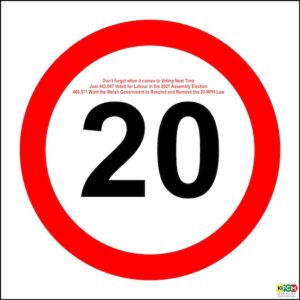
Labour and Plaid Cymru’s 20 MPH policy proved highly divisive. A 2024 poll indicated high opposition, with nearly 470,000 signatures on a Senedd petition to revert the change. Ignored by the Labour Government
2020
COVID business grant fraud and error
The Senedd’s Public Accounts Committee raised serious concerns about fraud and error in the Welsh Government’s Covid-19 business grants scheme, citing inadequate pre-payment verification and eligibility checks, compounded by poor record keeping.
Covid. £35.0m
2020
WCCIS: 10 years in, still far from realised
By mid-2020 only 15 of 29 target organisations had gone live with WCCIS. Over £30m had been spent by the Welsh Government and NHS Wales Informatics Service, with further ‘several millions’ from health boards and councils — yet key functionality remained undelivered.
Digital/IT. £30.0m
2019
M4 Relief Road abandonment
After 20 years and over £157m spent on planning, studies, land purchases and two public inquiries, the First Minister unilaterally abandoned the M4 relief road. Two properties were purchased just two months before the cancellation was announced.
Transport. £157.0m Lost Time and Productivity: The bottleneck at the tunnels, which often requires a 50 mph speed limit (and sometimes 30 mph) for traffic management and air quality, contributes to frequent traffic jams, with roughly 1,477 recorded in a 12-month period.
Traffic Volume vs. Capacity: The tunnels were designed for 30,000 vehicles a day but handle roughly 78,919, creating significant congestion.
2019
Betsi Cadwaladr director salary breach
A former director of nursing and midwifery at Betsi Cadwaladr was paid the equivalent of £465,000 per year — far exceeding the maximum allowed under Welsh Government rules. The health board also submitted incorrect account statements for 2021-22.
Health. £1.5m
2018
A465 Heads of the Valleys contract dispute
Major cost overruns and contractual disputes on the A465 dualling scheme led to substantial additional expenditure and years of delay, with individual section costs far exceeding original estimates due to ground conditions and design changes.
Transport. £60.0m
2016
Circuit of Wales motorsport collapse
The Welsh Government was drawn into prolonged, costly negotiations over a proposed £400m motorsport circuit near Ebbw Vale. Significant preparatory and advisory costs were incurred before the project collapsed without a site being built.
Industry. £12.0m
2015
WCCIS digital care record delays begin
The Welsh Community Care Information System was contracted in March 2015 with a target to go live across all 29 health boards and councils by 2018. Significant delays, functionality gaps and cost overruns would follow over the next decade.
Digital/IT £30.0m
2015
Betsi Cadwaladr enters special measures
Wales’ largest health board was placed in special measures in June 2015 — the first such action in devolved Wales — following institutional abuse scandals on mental health wards and serial governance failures. It would remain there for a decade.
Health. £45.0m
2015
NHS waiting times data mismanagement
Audit Wales found systematic failures in how health boards recorded and managed waiting times, leading to hidden demand, inaccurate reporting, and wasted administrative expenditure on recording systems that did not function correctly.
Health. £40.0m
2013
Natural Resources Wales formation costs
Merging the Environment Agency Wales, Forestry Commission Wales and Countryside Council for Wales into NRW cost more than anticipated, with extended transition periods, duplicated systems and the new body quickly requiring additional support.
Environment. £22.0m. https://www.itv.com/walesprogrammes/articles/wales-this-week-nrw-not-really-working
2012
RIFW land sale scandal
The Regeneration Investment Fund for Wales sold 15 publicly owned land plots at a fraction of their value. Lisvane land worth at least £39m was sold for £1.8m. The Public Accounts Committee found fundamental governance failures, costing taxpayers tens of millions.
Property/Land £50.0m Taxpayers Lose Out as Rhondda Cynon Taf Council Buys Back Land the Welsh Government Previously Sold Off Cheaply to a developer
2010
Ebbw Vale rail restoration delays and overruns
The restoration of the Ebbw Vale railway line took significantly longer than planned, with cost escalation and optimistic ridership forecasts that were not met for several years after opening.
Transport £15.0m
2009
Conwy coastal road emergency repairs
Repeated emergency spending on the A55 coastal route near Conwy due to storm damage and inadequate original infrastructure design. Long-term maintenance costs substantially exceeded projections.
Transport £8.0m
2007
WDA abolition and restructuring costs
Abolishing the Welsh Development Agency and absorbing its functions into the Welsh Government cost tens of millions in redundancies, property costs, IT migration and lost commercial momentum during the transition period.
Administration £20.0m
2005
Senedd building fivefold cost overrun
The National Assembly building in Cardiff Bay was originally budgeted at approximately £12m. The final cost reached around £67m — a fivefold overrun — due to multiple contractor changes, design revisions, and poor initial scope control.
Property/Land £55.0m
2002
Corus Llanwern closure regeneration shortfall
The Welsh Development Agency committed large sums to economic regeneration following the Llanwern steelworks closure, but much of the funding failed to produce sustained employment outcomes, with multiple successor schemes also underdelivering.
Industry. £30.0m
Sources: Audit Wales / Wales Audit Office published reports; Senedd Public Accounts and Public Administration Committee (PAPAC) findings; Welsh Conservative Party research notes; ITV Wales, BBC Wales, Nation.Cymru news coverage; official Welsh Government written statements. Figures represent confirmed losses, cost overruns, or estimated exposure where ranges are noted. The net zero estimate (£7.8–13.3bn) is a projected cost risk from independent analysis, not confirmed expenditure. All amounts in nominal £GBP at time of incident.
The dashboard is now updated with 29 incidents — here’s what’s new since the first version:
7 incidents added:
- Betsi Cadwaladr enters special measures (2015) — Wales’ largest health board placed under special oversight for the first time, where it would remain for over a decade
- Betsi Cadwaladr: decade in special measures (2023) — waiting lists nearly tripled from 86,845 to ~200,000 pathways during the period
- Betsi director salary breach (2019) — a nursing director paid £465,000/year, more than three times the permitted maximum
- WCCIS digital care record delays (2015–2022) — now split into three incidents tracking the £30m+ IT failure across its lifespan, including the 2022 strategic reset
- Conwy coastal road emergency repairs (2009) — repeated emergency transport spending due to poor original design
- A new Digital/IT category — added to capture WCCIS-type failures separately from health mismanagement
Related Posts
Plaid-Labour Budget Deal Reminds Us That A Vote For Plaid Is A Vote For Labour

When you wanted Welsh Labour to vote yes they Voted no so now it’s your chance to have your vote on the May 6th don’t waste it
Labour and Plaid vote against scrapping unpopular road building ban and 20mph

One thought on ““A Vote for Plaid is a Vote for Five More Years of Labour Waste””