
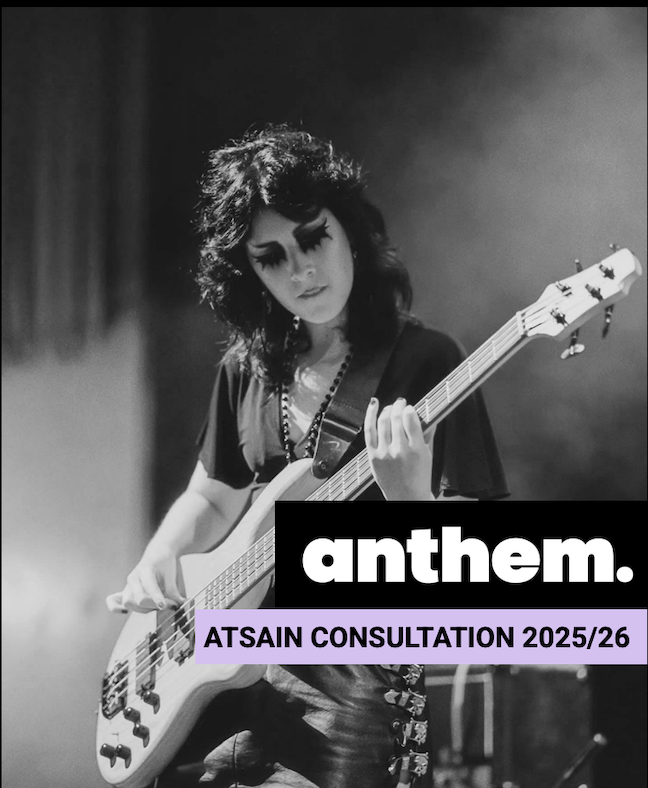
A new report from Anthem has revealed that young people are having more positive experiences with ‘in person’ music projects across Wales, but there are still many barriers for young people pursuing an interest and career in the music industry.
The Atsain Consultation Report, undertaken by Ella Beavington uncovered clear themes, including lack of spaces, finances, equipment, and transport networks, with ‘Confidence’ being the biggest barrier stopping young people from pursuing musical opportunities in Wales.
Despite these challenges, the consultation has highlighted the transformative value of accessible music projects for young people in Wales which have become vital safe, supportive spaces, to help build social connections and positive wellbeing amongst young people.
Anthem was established in 2018 following a Welsh Government report exploring ways to support young people’s music making and learning in Wales. Since its launch, Anthem has been listening and investing in young people and music, and building a network of partnerships in Wales and connecting with the UK scene.
Anthem was able to create a funding scheme to invest in youth music projects through its Atsain fund from 2022-2025. The feedback from the report highlights that the 56 local youth music funded projects in communities helped with connections, mental health and wellbeing and creating opportunities; but for the music sector to progress, support and investment needs to be sustainable.
“We know that lots of young people want to make, learn, or play music but it’s not always easy. Things like cost, travel, confidence, or even what’s available in their area can make it harder for them to get started. Despite these challenges, the consultation has highlighted the transformative value of accessible music projects for young people in Wales. The participants that Ella consulted with described meaningful increases in confidence, wellbeing, social connection and physical musical development as a direct result of their participation in the Atsain-funded projects.
Over the last year, Anthem has been reframing our work, and our new vision is a Wales in which young people lead a vibrant and connected youth music ecosystem. As Wales’ leading youth music charity, we create work that builds skills, confidence and community with young people who are passionate about music. We can only do this in collaboration with the wider youth music community across Wales, and the Anthem ethos is all about partnership, connecting organisations, and putting young people’s voices at the centre.”
Rhian Hutchings, Chief Executive Officer for Anthem.
Further conversations undertaken by Anthem with young people working with local youth music projects across Wales highlighted that community, encouragement, and confidence play a major role in musical engagement. Many participants spoke about friends, family, teachers, mentors, and youth organisations as key influences.
There was also a strong focus on education and early exposure. Participants described schools, youth clubs, community settings, family encouragement, and early opportunities to perform or experiment as key entry points into music. At the same time, they pointed to gaps in school provision, limited genre representation, and the need for broader music education that reflects contemporary forms and different ways of making music.
44% of young people in the research said that their family had helped them access their musical project.
Significantly, 24% of young people said social media played a key role in finding and connecting them to music opportunities. While Anthem understands the need for cultural change, now is the time for further in person investment for young people and projects.
Chair of Anthem, and founder of the original Pop Factory Music Complex in Porth, Emyr Afan OBE said:
“As Chair of Anthem, I know how much concern there is among parents, schools, youth organisations and young people themselves about the impact of addictive platforms, harmful content and always-on digital pressure. Keeping young people safe has to come first.
But this change also brings a practical challenge. Right now, social media is one of the key ways that organisations like Anthem to reach 14-16 year olds – especially those who are not already connected to formal music education, youth services or arts networks.
So alongside regulation, we need a clear plan for connection, participation and opportunity.
If young people are being asked to spend less time on social media, they need more real-world spaces where they can create, perform, belong and be heard. Music, sport, culture and youth-led activity cannot be treated as a nice-to-have. They are part of the infrastructure of wellbeing, confidence and community. The test of this policy will not only be whether young people spend less time online. It will be whether they have more meaningful opportunities offline.”
The full report can be viewed on the Anthem website
https://www.anthem.wales/wp-content/uploads/2026/06/Atsain-Consultation-Report-2025.pdf
Notes and quotes from participants who took part in the research:
Those who took part in the research responded positively to how music and opportunity locally has built their confidence and skills.
Benefits of in person projects:
“Being able to do music has helped me a lot in things like physics, it’s helped me a
lot in French, in Welsh, in chemistry and biology. Being able to communicate to other people’s music has helped me a lot. In English, holding a conversation, being able to play an instrument and play it properly, it’s like holding a conversation. Those moments of split silence that to us humans, we don’t recognise – you’ll recognise in music. It’s about being able to treat music fluently as we do English.” (Young person from Small Word project)
A member of Small World Projects said: “It teaches you very valuable like skills. You learn to deal with different kinds of people. […] If you’re able to work together with people, no matter what they’re like that’s very good. That’s so valuable.”
Confidence concerns:
As well as gaining positive experiences, confidence-related challenges showed an
intersection with previous discouraging experiences in school, anxiety and a lack of opportunities to develop skills in a supportive environment.
One of the clearest themes was the importance of accessible, safe spaces and infrastructure. Young people repeatedly identified rehearsal spaces, studios, equipment, instruments, and venues as essential to participation and progression. They spoke about needed places where they can practice comfortably, experiment, and develop without judgement, as well as practical access through transport links and affordable provision. For many, the issue is not a lack of interest in music, but a lack of local, accessible environments in which that interest can grow.
RecRock who are based in Caerphilly said:
“Social isolation [is] the biggest issue that young people and their parents [have] identified. Many young people feel it is hard to socialise or find people who have the same interests as they do. They identified a lack of activities in the school holidays, and parents noted that [our project] is one of the only times young people socialise away from their phones or computers.
Some of the barriers of young people at the moment is LGBT generational gaps, low
confidence, moments of anxiety, employability, and a lot of stigma around mental
health.”
Young people who lived locally to urban centres ended to have more access to music projects than those living in rural communities.
Small Word Theatre who are based in Cardigan said:
“Cardigan ranks high on the Welsh Index of Multiple Deprivation, with some of it’s wards being the most disadvantaged in the country. The area faces significant challenges, including low income, limited employment, and rural isolation. Young people in this area with an interest in music have few opportunities to connect with others or make music for free. These barriers contribute to poor mental health and limit access to the music industry. [Through our workshops we aim to address these barriers by] providing a supportive, well boundaried, non-judgemental environment where participants can build confidence, gain practical skills, and develop a sense of belonging. By offering free workshops and access to equipment, we make participation in music more accessible to those who might never have the change to engage with it.”
Porthi Dre, based in Caernarfon, said,
“The Cadnant and Peblig wards are among the most deprived areas in Wales. Many
children report no musical instruments at home and are aware that their families
cannot prioritise music lessons. There is a cultural belief that music is not a financially
viable career path. Caernarfon has a strong Welsh-speaking community. This, combined with its rural location, also limits access to music resources, often underrepresented and perceived as a middle-class pursuit.”
Wales One World Choir, based in Cardiff, said:
“Our choir is a lifeline for many people faced with restarting their lives in a new country; often in a language that is new to them. The language of music transcends these barriers. Many of the young people we engage with have experienced adversity in their lives as asylum seekers and refugees. They do not have access to funds to pay for out of school music making opportunities.”
Related Posts

‘All of us an opportunity to change things and move forward medicine’ – Royal College of General Government share tips to develop self-confidence and leadership skills
WelshLabour Spending £4.25m to purchase land for a music festival, a festival with just 21,000 visitors how is this money meeting the people’s needs for the other 3.134 million people of Wales
Charities campaigning for change should think hard before pursuing court cases
