
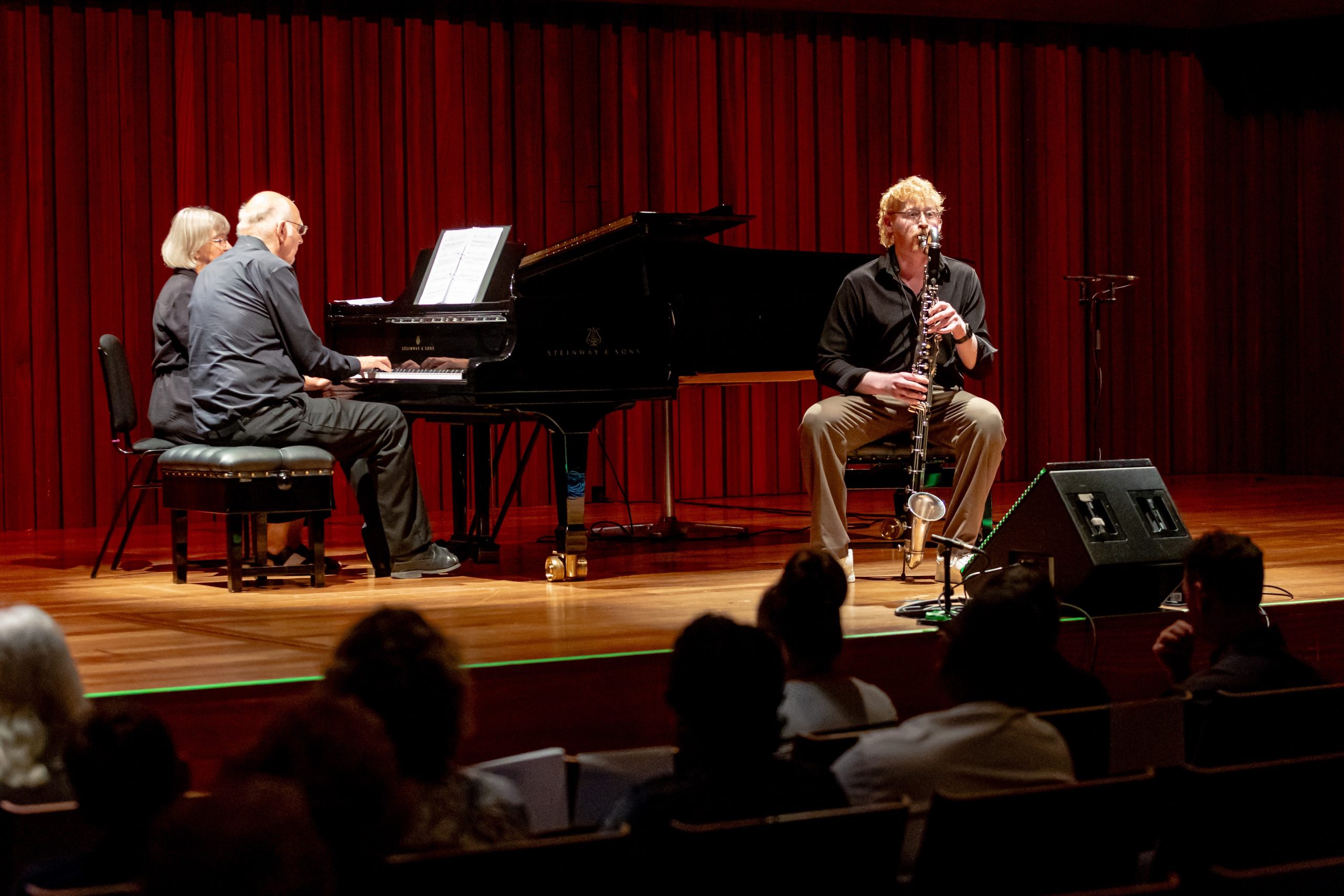
Two composers and musicians with sight loss from South Wales took
part in a very special showcase performance at London’s Guildhall
School of Music and Drama.
Gareth Churchill, 47, from Cardiff and Lloyd Coleman, 34, originally from
Bridgend, joined a group of talented blind and partially sighted musicians
to perform for an audience of music professionals, blind and partially
sighted people, and partner organisations on 3 rd July.
The event celebrated the twenty-fifth anniversary of the Elizabeth Eagle-
Bott Memorial Fund – a legacy donation administered by the Royal
National Institute of Blind People (RNIB) that provides vital support for
musicians with sight conditions in the UK.
Gareth, a composer who also plays the Clarion, lost his sight while at
university due to a stroke. The Clarion is an app that transforms an iPad
or Windows device into an accessible musical instrument that can be
played with any part of the body, including the eyes.
Gareth said: “Taking part in the Elizabeth Eagle-Bott event was an
enormous honour. I studied at Guildhall during the 90s and going back to
perform was so exciting, and it was great to feel the camaraderie
between the musicians. It was like coming full circle.
“There are definitely barriers to music for blind and partially sighted
people. Instruments, the extra time needed to learn to use accessible
resources, and specialist tuition all carry a cost. That’s why the Elizabeth
Eagle-Bott fund is so important for blind and partially sighted musicians
across the country.
“I learnt about the fund from a colleague when I joined Paraorchestra. I
applied for funding to buy a large screen iPad for reading music and
composing. I then discovered the Clarion, and it turned out I had the
perfect device to use it with. If it wasn’t for the Elizabeth Eagle-Bott fund,
I wouldn’t have my instrument and would be on a very different creative
journey.”
Lloyd is a Bridgend-born composer and musician currently working in
Bristol and London. He has nystagmus, and has applied for the
Elizabeth Eagle-Bott fund twice.
Lloyd said: “When I was Associate Music Director at Paraorchestra, our
aim was to show that disability need not be a barrier to excellence, as
long as you have the right conditions and tools in place.
“Through the fund, I was able to buy a bass clarinet for performance and
an iPad Pro, which I mainly use to read and enlarge sheet music.
Getting support from the Elizabeth Eagle-Bott fund has helped me to get
that iPad sooner than later and helped to put me on a level playing field.
All disabled musicians, if they have the right support, can achieve the
same things as non-disabled musicians.”
Other performers at the event included acclaimed soloist and graduate
of Canterbury Christ Church University, Charlotte Hardwick; lyric
soprano, Joanne Roughton-Arnold; recorder player and founder member
of the British Paraorchestra, James Risdon and Royal Conservatoire of
Scotland graduate and tenor, Zachary Smith.
Elizabeth Eagle-Bott was herself a talented musician and was inspired to
leave a legacy to RNIB after attending an organ recital by a blind
musician. Over 25 years, the Elizabeth Eagle-Bott Memorial Fund has
awarded approximately £500,000 to alumni and provided support from
specialist equipment to adapted instruments and computers. All of those
who performed at the event have received support from the fund.
RNIB Cymru Director Ansley Workman said: “We are so grateful to
Elizabeth Eagle-Bott for her visionary gift, which has supported brilliant
3
musicians across the UK and enabled Welsh talents like Gareth and
Lloyd to hone their craft and build successful careers in music. The
evening was a celebration of an exceptionally talented group of people,
and we hope the fund can continue to support the careers of many more
up and coming musicians.”
RNIB’s Music Support Officer Daisy Higman, said: “There are many
extra costs and barriers that blind and partially sighted musicians face,
that sighted musicians don’t. It could be extra braille music tuition or
transcription or having to pay extra for accessible music equipment and
software.
“I don’t know if Elizabeth Eagle-Bott would have ever dreamed that her
bequest would have this sort of impact and it was so wonderful that we
could bring together some of the talented musicians whose lives and
careers have been changed by this fund.”
About the Elizabeth EagleBott Memorial Fund
The Elizabeth EagleBott Memorial Fund was established through Miss
M. E. EagleBott’s 1987 Will, which directed one of the largest bequests
RNIB had received at the time to support the training and development
of blind musicians, originally with a particular focus on blind organists
and classical music. Over the years, the fund has shifted focus to reflect
the changing interests, tastes and careers of blind and partially sight
musicians.
RNIB administrates the fund, with the oversight of an independent panel.
It is open to all blind and partially sighted people aged 18+ and living in
the UK, wishing to engage in music or music-related activities.
The fund is unique in the UK in offering substantial financial awards
specifically for blind and partially sighted musicians, and in maintaining
an expert panel with the majority of the people on the panel living with
sight loss.
Related Posts

Celebrate St David’s Day and raise money to help support people living with sight loss in Wales

South Wales sight loss campaigner wins RNIB Campaigner of the Year Award
Sight loss charity urges people in South Wales to visit their optician