
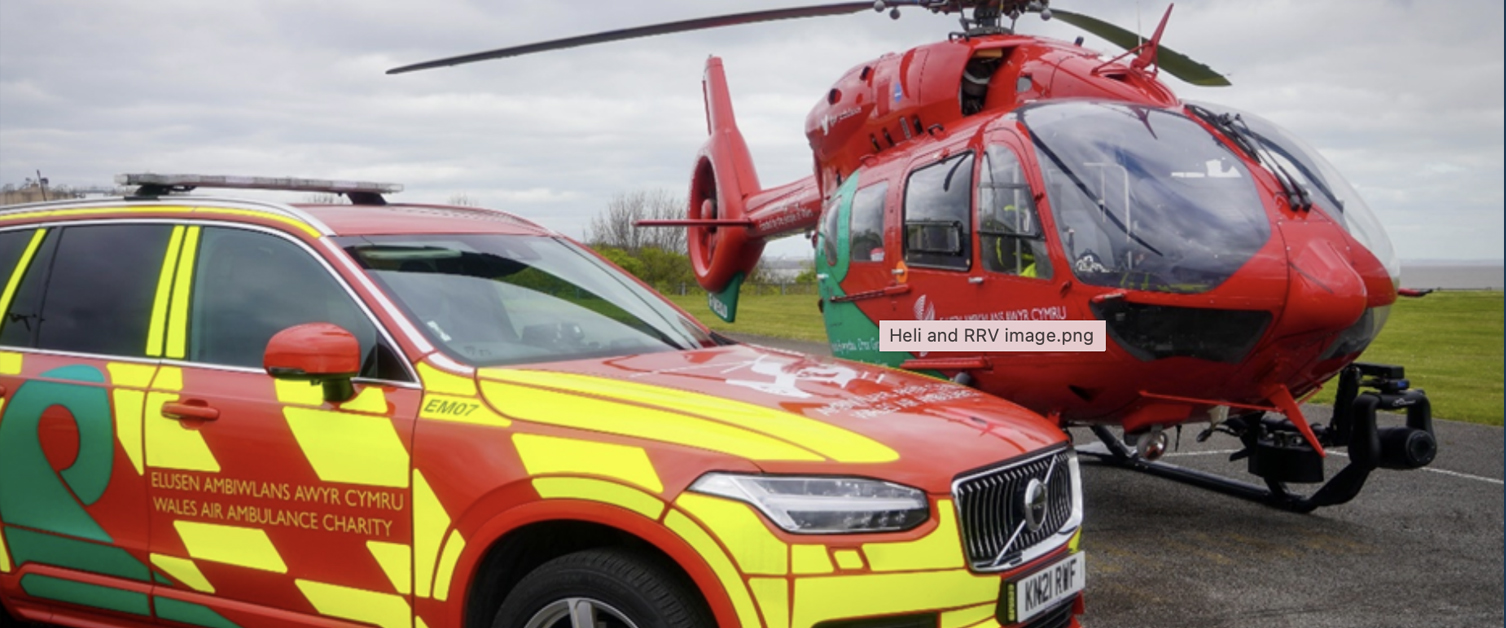
One of the world’s busiest heliports is playing a ‘key role’ in helping Wales Air Ambulance
save more lives.
Wales’s air ambulance service attends around 3,500 patients annually. A number of those
will require care in specialist hospitals in other parts of the country.
Several times a year, clinicians will transfer children to St Thomas’ Hospital and that’s where
London Heliport offers the perfect landing location for air ambulances. It is situated opposite
Chelsea Harbour on the south bank of the River Thames.
Andrew Morris, Wales Air Ambulance Helicopter Transfer Practitioner, said: “The team at
London Heliport are incredible – they know how air ambulances across the UK operate and
how they must raise millions of pounds each year to run their service.
“We are just so grateful that each time we ask them for assistance, they always let us in.”
He continued: “When we have a specialist transfer or retrieval, we have few choices where to
land.
“Some hospitals have their own helipads, but because they are set up as major trauma centres,
they don’t want a helicopter sat for hours, while we undertake a transfer.
“The team in Battersea understand what we are up against and always accommodate us. We
can bring the road ambulance straight up to the helicopter.
“They give us all the privacy we need, preserving patient dignity whilst they are critically
ill.”
The Wales Air Ambulance is consultant-led, taking hospital-standard treatments to the
patient and, if required, transferring them directly to the most appropriate hospital for their
illness or injury.
It is delivered via a unique third-sector and public-sector partnership. The Wales Air
Ambulance Charity relies on public donations to raise the £11.2 million required every year
to keep the helicopters in the air and rapid response vehicles on the road.
The Emergency Medical Retrieval and Transfer Service (EMRTS) supplies highly skilled
NHS consultants and critical care practitioners who work on board the Charity’s vehicles.
This advanced critical care includes the ability to administer anaesthesia, deliver blood
transfusions and conduct minor operations, all at the scene of an incident.
As a pan-Wales service, its dedicated crews, regardless of where they are based, will travel
the length and breadth of the country to deliver emergency critical care.
Andrew, who has worked for the service since 2017, said: “I’ve lost count over the years of
how many times I have flown into London Heliport.
“Sometimes we can be there twice a month, or it might be one job every three to four
months.”
In September 2023, Andrew and his colleagues were tasked to support the transfer of a
premature baby from St Thomas’ Hospital in London to North Wales.
They initially flew from Cardiff to Ysbyty Glan Clwyd to collect a neonatal team who were
taking over the care of the infant who was born at 32 weeks.
The child’s mother, who wishes to remain anonymous, was staying with her sister in
Hackney, London, when she started experiencing severe stomach pains. On admission to
hospital, she was found to be in the early stages of labour.
She said: “I was in terrible pain and thought at first that it couldn’t be labour because I was
two months away from my due date.
“But within hours it had intensified and by midnight I was giving birth to my daughter. It was
such a difficult time for me, and I am so grateful that my mother and sister were there to
support me.
“They would visit me two to three times a day, bringing homemade food and supporting me.
I am not sure how I would have got through those first few days without them by my side.”
The newborn was placed in an incubator, required feeding through a nose tube and received
intravenous medication due to her premature birth.
Her mother said: “Like any new mum, all I wanted to do was be at home holding my baby.
But it was over two months before that became a reality.
“First, my daughter needed to be transferred back to North Wales. We had to wait for a
helicopter to be available to collect her.”
Wales Air Ambulance landed at London Heliport. They needed to stay on the helipad for
three hours, whilst clinicians went to St Thomas to collect the baby.
Her mother added: “I initially travelled with her by road ambulance to London Heliport and
watched her being placed into the helicopter.
“It was such a relief to know her journey would be quick. My mother and sister travelled
ahead by road to join my husband; they waited for her arrival on the other side.
“The helicopter is such a small space and because the neonatal team were onboard, there was
no room for me, so once I knew she was safely onboard, I took the train, joining my family
four hours later in Rhyl.”
Andrew said: “Sometimes we can be on the helipad an hour or two. But the day we picked up
the baby was a particularly long one and we were so grateful to London Heliport for helping
us out.
“It started with a flight at 9am from Cardiff to Ysbyty Glan Clwyd, then a flight over to
London Heliport, a road journey to St Thomas’, a patient transfer back to the helicopter, a
flight back to Ysbyty Glan Clwyd and then arriving back in Cardiff, around 8pm.
“It was an incredibly busy day, but it all went very smoothly thanks to our colleagues at
London Heliport.”
The baby is now a toddler and has no health complications as a result of being born
prematurely.
Her mother said: “I am so grateful to Wales Air Ambulance and London Heliport for all the
kindness and care they showed my daughter.
“In the following weeks, I was able to visit her three or four times a day, at the neonatal unit
at Ysbyty Glan Clwyd, which was so very important to me.
“She was meant to be born on October 31 st – and was allowed to come home for the first time
that week.
“We are looking forward to celebrating her second birthday with family and friends.”
Amanda Etheridge, Head of Nursing for Children’s Services in the Central area of Betsi
Cadwaladr University Health Board, said: “When a premature or critically ill baby arrives
with us, it’s often the final step in what has already been a highly complex and emotional
journey.
“The ability of Wales Air Ambulance to carry out long-distance neonatal transfers safely and
swiftly is absolutely vital — and the support from London Heliport plays a key role in
making that possible.
“Their willingness to accommodate the team for extended periods means our tiniest patients
arrive in the best possible condition, and families can be reunited sooner. We’re very proud to
work alongside such dedicated partners in care.”
London Heliport Manager, Matthew Rice, said: “It’s wonderful to find out that one of the
patients that have benefited from a transfer from our base, is doing well.
“We are honoured to be able to help Wales Air Ambulance in any way we can. The medical
teams are outstanding and do an incredible job.
“I love what the service does, but each time I see a red helicopter, I know it’s because
someone is sick and as a dad, it breaks my heart when I see little babies transferred in their
incubators.
“But I think the Charity is phenomenal and if we can help with costs, we will. We would
rather the money raised by supporters be put towards helping save more lives!”
Matthew says ‘no day is the same’ at his base. He continued: “We could work with private
individuals flying in for the day or corporate companies negotiating trade deals. Last year we
saw 9,000 movements at our base.”
Its busiest periods are around special events like Ascot, Glastonbury and the Grand Prix. The
heliport has featured in films and TV programmes. But he admits the ‘proudest moments’
have involved ‘working with critical care providers like Wales Air Ambulance’.
He said: “We’ve always had a link with air ambulances, due to the lack of landing sites in
London. It is helpful to have us as a separate point to enable the London Ambulance Service
to access flying patients. It’s a good central location to drop off and pick up.
“There is always this general misconception that we are purely for the rich and famous. But
we will always give air ambulances access and will do our best to accommodate them for as
long as they need.”
Related Posts

Welsh Ambulance Service on target again during busiest month on record
Welsh Ambulance Service appeals for public to help save lives by clearly displaying house numbers
Urgent intervention needed to save Air Ambulance Service