
A staffing crisis that paused specialist palliative care at Ysbyty Cwm Cynon in Mountain Ash has prompted a difficult question for communities in Rhondda Cynon Taf and Merthyr Tydfil: if the health board cannot recruit enough specialist staff for Ward 6, how will it recruit the workforce needed for a major new healthcare centre being built nearby?
The answer is not as simple as moving staff from one site to another. The two projects involve different services, different professional groups and different operating models. But the concern is legitimate: Cwm Taf Morgannwg University Health Board is planning new capacity while acknowledging that recruitment and retention remain serious problems across its services.
What happened at Mountain Ash?
Specialist palliative care on Ward 6 at Ysbyty Cwm Cynon was paused after medical staffing shortages made it impossible to operate the consultant-led service safely, according to the health board’s engagement material. CTMUHB says there is a national shortage of palliative-care doctors, recruitment in CTM is especially challenging, and vacancies and absences have a significant effect because the team is small. General end-of-life care has continued, but that is not the same as a dedicated specialist inpatient unit for patients with complex symptoms or unstable conditions.
The health board’s current proposal is to close the Merthyr and Cynon specialist inpatient unit and strengthen its two purpose-built units: Y Bwthyn at the Royal Glamorgan Hospital in Llantrisant and Y Bwthyn Newydd at the Princess of Wales Hospital in Bridgend. It also proposes expanding community specialist palliative care, Hospice@Home and end-of-life care in community hospitals.
The proposal has caused anger locally. A Senedd petition says the eight-bed unit is important for patients with complex needs, people without suitable support at home and families needing respite. A separate account of the campaign reported that more than 3,000 people had backed petitions calling for the service to be retained.
CTMUHB says the aim is not to withdraw end-of-life care from Mountain Ash. Its stated plan is to retain community-hospital end-of-life care at Ysbyty Cwm Cynon, while concentrating specialist inpatient beds at the Royal Glamorgan and Princess of Wales hospitals. The health board also says it wants care to be sustainable and available closer to home where that is clinically appropriate.
What is being built at Llantrisant?
The new Llantrisant Health Park should not be confused with Y Bwthyn, the specialist palliative-care unit already operating on the Royal Glamorgan Hospital site. Y Bwthyn is an existing eight-bed specialist unit serving the Rhondda and Taff Ely area. CTMUHB lists it as the base for that area’s specialist palliative-care team and says it provides inpatient specialist care at the Royal Glamorgan Hospital.
The new Health Park is a separate development. Phase one is planned as a regional Community Diagnostic Hub providing MRI, CT, ultrasound, X-ray and endoscopy services, together with a training centre. The project is led by CTMUHB in partnership with Cardiff and Vale and Aneurin Bevan health boards; the health board says the partnership is intended to share specialist staff and diagnostic and surgical capacity.
That distinction matters. The new centre is not being built as a replacement palliative-care ward, and the evidence available does not show that it will be privately operated or staffed by palliative-care specialists. It is primarily a diagnostics and planned-surgery project. Its workforce will include radiographers, radiologists, sonographers, healthcare scientists, endoscopy staff, nurses, support workers and other clinical and administrative employees—not necessarily the consultants and specialist palliative-care doctors whose shortage affected Ward 6.
Could the new centre face staff shortages?
It could. The health board’s own case for changing specialist palliative care says there is a national shortage of palliative-care doctors and that recruitment in CTM is particularly difficult. It also says vacancies and staff absences have a significant effect because the specialist team is small.
The regional model may reduce that risk by allowing the three health boards to share some staff and capacity; CTMUHB says the partnership is intended to make better use of specialist staff and shared diagnostic and surgical capacity. The proposed training centre may also help develop the workforce over time. But buildings do not create clinicians. A diagnostic hub can be completed on schedule and still face delays, reduced opening hours or reliance on agency staff if the health boards cannot fill the posts needed to run it.
There is also a risk of competition between services. If CTMUHB recruits radiographers, nurses, healthcare scientists or support staff for the Health Park, those workers may be drawn from the same regional labour market as existing hospitals and community services. Whether that happens will depend on the posts created, the funding attached to them, recruitment success, retention and the extent to which Cardiff and Vale and Aneurin Bevan contribute staff rather than simply sharing demand for the facility.
The health board has not published evidence that the new Health Park will be unable to operate because of staffing. Nor has it published, in the material reviewed for this story, a complete workforce plan showing how many staff the centre will require, how many are already available, how many new posts will be created and how vacancies will be protected from competing services.
The question CTMUHB must answer
The central issue is not whether a new building can be opened. It is whether CTMUHB can demonstrate that the workforce plan for the Health Park is credible without weakening services elsewhere.
That should include a public breakdown of:
- the number and type of staff needed for each phase of the Health Park;
- which posts will be new and which will be transferred from existing services;
- how staffing will be divided among the three health boards;
- the recruitment and retention plan for hard-to-fill roles;
- the use of agency and temporary staff;
- the safeguards for Ward 6, community hospitals and existing diagnostic services; and
- the contingency plan if vacancies delay the centre’s opening or limit its hours.
At present, the fair conclusion is neither that Llantrisant will inevitably suffer the same fate as Mountain Ash nor that the new centre is protected from the workforce crisis. The two services need different skills, and regional collaboration could make recruitment easier. But CTMUHB’s own explanation for the Mountain Ash proposal confirms that staffing is already a system-wide constraint.
The new Health Park will therefore be judged not only by its equipment and buildings, but by whether it has enough permanent staff to operate safely—and whether investment in a new facility is matched by a credible plan to sustain the services communities already depend on.
This article is based on CTMUHB’s published specialist-palliative-care engagement material and Health Park information, together with publicly reported community and council concerns. The health board’s engagement period ran from 11 February to 1 April 2026; a final decision on the Mountain Ash proposal should be confirmed with CTMUHB before publication.
Cwm Taf Morgannwg University Health Board was contacted for comment. A spokesperson stated they were looking into the matter, but no full statement was received prior to publication.
Cabinet Minister Visits Llantrisant Health Park Development
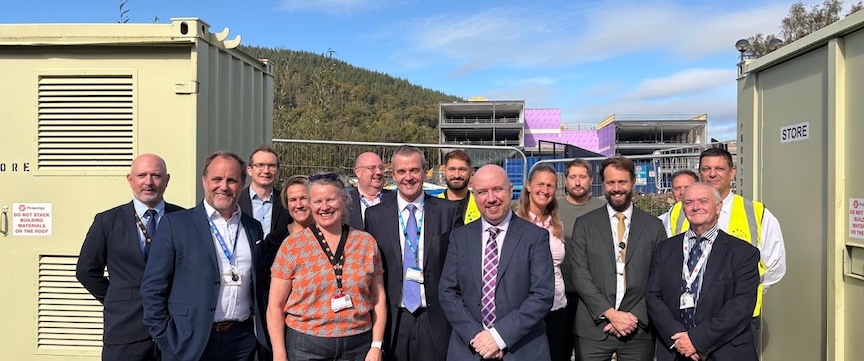
The Welsh Government Cabinet Minister for Health and Care, Mabon ap Gwynfor, today, Monday 21 September, visited the site of the new Llantrisant Health Park, a major healthcare development that will enhance access to diagnostics and planned care for communities across south-east Wales.
During the visit, the Minister was able to enter the modular shell of the new building and was given an update on progress at the development, located near the Royal Glamorgan Hospital.
The first phase of the project, due to open late in 2027, will deliver a state-of-the-art Community Diagnostic Hub, providing MRI and CT scanning, ultrasound, X-ray and endoscopy services, alongside a dedicated training centre for the future NHS workforce. On Sunday the Minister announced £121m for phase two of the development which will include a regional arthroplasty surgical hub.
Led by Cwm Taf Morgannwg University Health Board in partnership with Cardiff and Vale University Health Board and Aneurin Bevan University Health Board, the Health Park is designed to increase diagnostic capacity, support faster access to tests and treatment, and help reduce waiting times across the region.
During his visit, the Minister met project leaders and partners involved in delivering the development, highlighting the importance of investing in modern healthcare facilities and strengthening regional collaboration to improve patient outcomes across south-east Wales.
Paul Mears, Chief Executive of Cwm Taf Morgannwg University Health Board, said: “The progress being made at Llantrisant Health Park is a clear demonstration of our commitment to transforming healthcare across the region. This landmark health care facility will help reduce waiting times, improve access to services and support the delivery of high-quality care for generations to come. We were delighted to welcome the Cabinet Minister and share our vision for this exciting development.”
Construction of the first phase is underway, marking an important milestone in the delivery of a facility that will play a key role in supporting the long-term healthcare needs of communities across south-east Wales.
Mabon ap Gwynfor, Cabinet Minister for Health and Care, said: “It’s been great to visit the site of the new Llantrisant Health Park and see the progress being made on what will be a truly transformative facility. The investment announced on Sunday
underscores the ambition of this Government in delivering on our key priority to cut waiting times, as well as building greater long-term sustainability in the system so that waits stay down.
“This will bring modern, purpose-built facilities to the area and help ensure people can be seen quicker for the treatment they need.
“I look forward to seeing the site continue to develop and take shape over the coming months, before welcoming its first patients. Llantrisant Health Park is a significant step forward for healthcare in the region, and will play a vital role in our commitment to seeing a stronger, more responsive and more sustainable NHS that works for everyone.”
Related Posts

NHS Wales staff shortages sees agency staff up 171% in seven years

Fight to Save Mountain Ash Palliative Care Ward as Health Board Eyes Closure

NATIONAL GARDEN SCHEME FUNDS NEW PALLIATIVE CARE MACMILLAN UNIT NEAR LLANTRISANT