
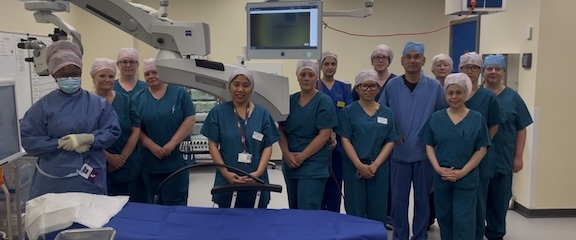
Patients across Cwm Taf Morgannwg are benefiting from improved access to cataract surgery thanks to a regional programme that has delivered more than 25,000 procedures across South-East Wales in the last 12 months.
The Regional Ophthalmology Programme brings together teams from Cwm Taf Morgannwg, Aneurin Bevan and Cardiff and Vale University Health Boards to increase surgical capacity, improve patient care and reduce waiting times. Through this collaborative approach, almost 10,000 patients have come off regional waiting lists, helping more people access sight-restoring treatment sooner.
Cataract surgery is a day procedure that is usually completed within an hour and involves replacing a cloudy natural eye lens with a clear artificial one. In response to growing demand for treatment, the three health boards came together in 2023 to review how resources could be used more effectively and increase the number of operations being carried out across the region.
Following a 12-week public engagement period to seek patients’ views on the proposed plans, the programme developed two regional cataracts ‘hubs’ to provide additional clinical capacity – one in the North of the catchment area at Nevill Hall Hospital in Abergavenny, and another in the South at University of Wales Hospital in Cardiff.
Alongside the hubs’ activity, the programme was backed by an additional £19.5 million of Welsh Government funding in April 2025 to further tackle cataract waiting lists by outsourcing to independent providers across Wales and England. With an ambitious target of outsourcing 12,930 cataract treatments between April 2025 and March 2026, the programme not only met but exceeded its target; delivering 12,976 sight-restoring surgeries across a network of five specialist providers.
This additional activity, when combined with the existing cataract treatment performed across each of the three Health Boards and both regional hubs, resulted in a total of 25,633 surgeries between April 2025 and March 2026 (with a proportion of patients receiving treatment in both eyes).
The impact of this work has been substantial in helping to speed up patients’ waiting times; reducing the cataracts waiting list by more than 9,600 people.
Rhianon Reynolds, the Programme’s Regional Clinical Lead and National Clinical Lead for Ophthalmology, said:
“Our teams have worked extremely hard to deliver this ambitious programme. Despite the scale and pace of delivery, which was equivalent to two years of routine activity compressed into twelve months, we ensured that the programme maintained strong clinical oversight and patient-focused care throughout. We’re really pleased to have consistently received positive patient feedback for the regional hubs and our external partners.”
Hannah Evans, Executive Director of Strategy, Planning and Partnerships at Aneurin Bevan University Health Board, said:
“This work set out to improve equity of access to cataract surgery across the Health Boards and provide timely, safe and high-quality care. I’m delighted to see the significant impact on patients’ waiting times and experiences and would like to thank our Health Board colleagues and external partners for their dedication and support in delivering this programme.”
“While demand for cataract surgery across the region remains high, the regional programme has made major progress in improving access to cataract surgery and building a stronger, more resilient system for the future.”
Related Posts

South Wales health board unveils multi-million pound ‘Diagnostics Hub’ to expand radiology capacity across the region
Labour-run Wales continues to suffer from an absence of surgical hubs
Major New Healthcare Development for South East Wales: Llantrisant Health Park
