

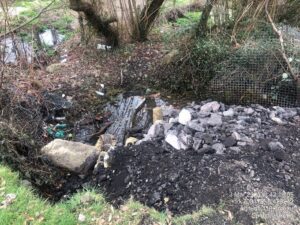
The photograph above shows a section of the Cwmbach Community Wetlands, where tons of construction road waste were dumped into a natural depression. Following Storm Babet, the waste was pushed further into the wetland ecosystem. Although a fence has now been erected, the hole remains exposed and vulnerable to future weather events, with the next storm likely to bring down the temporary barrier.
Natural Resources Wales (NRW) has stated that it is not in the public interest to investigate this incident, despite its own published policies suggesting otherwise. This response is supported by the press office of Huw Irranca-Davies MS, Deputy First Minister and Cabinet Secretary for Climate Change and Rural Affairs. It appears there is one standard for official response and another for public expectation, undermining trust and transparency.
Today from the Climate Change Press Office:
“Thanks for sending through your query – there’s nothing more to add to the information you were given previously:
- Natural Resources Wales, as the independent environmental regulator, investigates environmental incidents and takes appropriate enforcement action as necessary.
- NRW attended the reported area to investigate the fly-tipping incident and based on its onsite observations, NRW deemed it not to be in the public interest to continue with the investigation and the incident was closed.
- NRW, an arms-length body which is independent of the Welsh Government, has its own two-stage complaints procedure that it must follow.
- If members of the public remain unsatisfied with the outcome of NRW’s investigations into the complaint, they may wish to consider referring the matter to the Public Services Ombudsman for Wales, who is best placed to investigate further.”

The Public Services Ombudsman for Wales has reportedly said the case is out of time to investigate. But is it really? When visible environmental damage continues and when public authorities appear to be in breach of their own obligations, time limits should not be an excuse for inaction.
Welsh Audit Office: Press Release
Environment (Wales) Act 2016
The Wales Audit Office has previously been informed of the blatant disregard shown toward the Environment (Wales) Act 2016 by both Rhondda Cynon Taf County Borough Council and NRW.
Many public authorities in Wales have failed to comply with key biodiversity requirements, including the Welsh Government itself.
Our latest report highlights various areas for improvement at a time when the Welsh Government is considering changes to environmental law.
In 2015, the Welsh Government’s Nature Recovery Action Plan (NRAP) recognised that Wales was far from reaching national and international biodiversity goals. Data now shows that Welsh wildlife decreased on average by 20% between 1994 and 2023, and around 1 in 6 Welsh species were at risk of extinction in 2023.
The Environment (Wales) Act 2016 aims to reverse the decline in biodiversity. Among other things, it places an enhanced biodiversity and resilience of ecosystems duty on public authorities. The Senedd has since declared a nature emergency and the Welsh Government has committed to embedding its response across all activities.

However, more than eight years since this duty came into force:
- Nearly half of public authorities have not complied with the requirement to both prepare and publish a biodiversity plan.
- Around a quarter of public authorities have never produced a biodiversity report, despite clear guidance and a reporting template.
- The Welsh Government has not complied with its own planning requirement, is not effectively monitoring compliance, and cannot assess the duty’s overall impact.
- Weaknesses in the Act and guidance leave coverage and intent open to interpretation.
The report acknowledges some positive initiatives and funding streams, including £120 million toward Local Places for Nature and Nature Networks programmes. However, national focus remains skewed toward decarbonisation, with biodiversity given far less attention.

Auditor General Adrian Crompton commented:
“The duty set out in the Act ought to be a powerful statement about the need for all public authorities to take decisive action on biodiversity decline. But good intentions and examples of funding for biodiversity action are not enough. The Welsh Government itself needs to do more to lead by example, support improvement, and take a more active interest in the application and impact of its own legislation. It has an opportunity to do just that as it considers change to environmental law but will need to ensure this area of work gets the priority it deserves if it is to reverse nature loss for future generations.”
Conclusion
The refusal to fully investigate the Cwmbach Wetlands incident appears to be part of a broader pattern of institutional indifference, as highlighted by the Auditor General. The public deserves clear answers and proactive enforcement of environmental law, not deflection and delay. Now is the time for action—before the damage becomes irreversible.
The nature emergency has not been a high enough priority
Many public authorities in Wales have failed to comply with key biodiversity requirements, including the Welsh Government itself in one respect
Our latest report highlights various areas for improvement at a time when the Welsh Government has been considering changes to environmental law.
In 2015, the Welsh Government’s Nature Recovery Action Plan (NRAP) recognised Wales was far from reaching national and international biodiversity goals. Data now shows that Welsh wildlife decreased on average by 20% between 1994 and 2023. And around 1 in 6 Welsh species were at risk of extinction in 2023.
The Environment (Wales) Act 2016 aims to reverse the decline in biodiversity. Among other things, it places an enhanced biodiversity and resilience of ecosystems duty on public authorities. The Senedd has since declared a nature emergency and the Welsh Government has said it will embed its response to the climate and nature emergency in everything it does.
More than eight years since the duty came into force, we found that nearly half of public authorities covered by our work have not complied with the requirement to both prepare and publish a biodiversity plan. And approaches to planning vary widely. Around a quarter of public authorities have never produced a biodiversity report. This is despite the Welsh Government providing reporting guidance and an optional template.
We also found that the Welsh Government has not complied with its own planning requirement, is not effectively monitoring public authorities’ compliance, and is currently unable to assess the overall impact of the duty on biodiversity decline. Meanwhile, weaknesses in the Act and its guidance leave their coverage and intent open to interpretation.
Our report acknowledges examples of efforts to integrate biodiversity and nature ambitions with wider policies. And public authorities provided positive feedback on aspects of national strategic leadership. The Welsh Government has also provided various funding streams that support biodiversity action. These include around £120 million over recent years for the Local Places for Nature and Nature Networks programmes. Nevertheless, there has been far less national focus on biodiversity than on decarbonisation.
We highlight various areas for improvement. Several of these issues have not been addressed fully since being highlighted in a 2021 evaluation. They include uncertainty about which public authorities are covered by the duty, and the need to strengthen Welsh Government guidance and monitoring. Our recommendations relate mainly to the current duty. However, we recognise that the Welsh Government will need to consider its actions alongside its proposals to change environmental law.
Related Posts

National Audit Office to investigate local government governance and accountability

Watchdog criticises public bodies in Wales over failure to comply with biodiversity duty
What is RCT Council using for infill next to Cwmbach Wetlands

One thought on “Failure to Investigate Environmental Damage at Cwmbach Wetlands: A Concern for Public Accountability”
Comments are closed.