

Fresh concerns have been raised over the condition of Aberdare Park after residents described large areas of the historic Victorian park as being covered in goose droppings just weeks after it underwent its annual Green Flag inspection.
During a visit to the park on 8 July, AberdareOnline observed extensive goose fouling on footpaths surrounding the lake and across adjacent grassed areas. The affected paths are among the busiest in the park, used daily by families, walkers and visitors accessing the children’s splash pad, café and boating lake.
The condition of the park has prompted renewed questions over maintenance standards and whether the level of cleanliness expected during the Green Flag judging process has been maintained since inspectors visited.

Residents question maintenance standards after photographs reveal heavily fouled footpaths just weeks after Green Flag inspection
For generations, Aberdare Park has been regarded as one of Wales’ finest Victorian public parks—a place created to improve public health, provide recreation and offer visitors a clean, welcoming environment.
Today, many residents believe that reputation is under threat.
During a visit to Aberdare Park on 8 July 2026, AberdareOnline found extensive goose fouling across large sections of the main footpaths surrounding the lake, including routes leading towards the children’s splash pad. Photographs taken during the visit show droppings covering significant stretches of paths used daily by families, walkers and visitors.

The condition of the park has prompted renewed questions about maintenance standards and the effectiveness of long-standing efforts to manage the growing goose population.
Green Flag inspection took place in May
Following an enquiry to Keep Wales Tidy, AberdareOnline confirmed that Aberdare Park’s annual Green Flag Award inspection took place on 5 May 2026.
Less than two months later, the condition of the park’s footpaths appears very different.
The Green Flag Award recognises parks that are welcoming, safe, clean and well managed. Readers can now compare those standards with the accompanying photographs showing the current condition of the lakeside paths.
During our visit, goose droppings were visible across lengthy sections of the main pedestrian routes surrounding the lake and close to facilities used by families.

During AberdareOnline’s visit, council staff were observed watering flower beds while the heavily fouled footpaths remained untreated. Although maintaining the park’s floral displays is important, several visitors questioned whether cleaning the most heavily used pedestrian routes should have been given greater priority.
Residents say complaints have gone unanswered
Several visitors told AberdareOnline they had repeatedly complained about the goose fouling but believed little had changed.
One resident said:
“I’ve spoken to the park manager several times about the goose mess, but nothing seems to happen.”
Another described himself as “fed up complaining”, while others echoed similar concerns, saying the issue had become progressively worse over recent years.
Many questioned whether visitors should have to negotiate heavily fouled paths to reach one of the park’s most popular attractions—the splash pad.
Regular feeding continues
During the visit, AberdareOnline observed a visitor carrying bird food to the lake beside the splash pad.
Within moments, dozens of geese and ducks gathered around him as he scattered food along the lakeside and continued feeding the birds while walking around the lake.
The feeding took place within sight of park staff.
The incident highlights one of the central difficulties facing the council. While visitors continue to feed the birds, efforts to reduce the resident goose population become significantly more difficult.
The incident occurred within sight of park staff.

A man feeds dozens of geese beside Aberdare Park’s lake, just metres from the splash pad. Residents say regular feeding continues to attract large numbers of birds despite requests from the council asking visitors not to feed waterfowl.
Council has acknowledged the problem for several years
The issue is far from new.
Over the past three years AberdareOnline has repeatedly questioned Rhondda Cynon Taf Council about the growing goose population, cleaning standards and wildlife management.
Previous correspondence shows the council has described enhanced cleaning regimes, discussions with Natural Resources Wales and the RSPB, increased cleansing operations and plans to discourage visitors from feeding the birds.
Freedom of Information responses have also confirmed the council does not separately record the annual cost of cleaning goose fouling in Aberdare Park, despite acknowledging that cleansing operations have been increased because of the problem.
Despite those assurances, residents say the condition of the footpaths remains unacceptable.

Council Leader also a Friends trustee
The issue also raises questions about governance.
Council Leader Ann Crimmings has confirmed she is also a Trustee of Friends of Aberdare Park, an organisation closely associated with the park. She has confirmed that this interest has been formally declared in accordance with the council’s procedures and said operational decisions affecting the park are taken by the local authority in consultation with organisations including Natural Resources Wales and the RSPB.
Mrs Crimmings has also confirmed that Friends of Aberdare Park stopped selling bird food approximately two years ago after advice that reducing feeding could help reduce goose numbers.
Would a footpath in this condition, leading to the Splash Pad at Aberdare Park, be considered acceptable in Ynysangharad War Memorial Park, home of the National Lido of Wales?

Aberdare Park and Ynysangharad War Memorial Park are both Green Flag Award-winning parks. Should visitors expect the same standards at both?
Council announces new Geese Management Strategy
Following AberdareOnline’s request for comment, Rhondda Cynon Taf Council provided details of a new Geese Management Strategy, saying park staff “share the concerns of visitors”.
The authority says measures now being introduced include:
- fencing around the island used by nesting geese;
- additional planting to discourage birds from landing;
- new signs asking visitors not to feed the birds;
- increased ranger patrols;
- using lake fountains to create ripples that deter geese;
- reducing grassed areas by introducing wildflowers and meadow planting.
The council said it continues to welcome suggestions from visitors.
Whether these measures prove effective remains to be seen.

Green Flag response
Keep Wales Tidy also responded to AberdareOnline’s enquiries.
Joanna Friedli, Regional Manager for Central East, acknowledged that goose fouling is “a recognised management challenge at many sites across the UK” and said Rhondda Cynon Taf Council was actively reviewing the issue.
She added:
“At this time the site continues to meet the required Green Flag Award standards, however we will continue to monitor the issue of wildfowl management as part of our assessment process.”
Readers will inevitably compare that assessment with the photographs accompanying this article.

An estimated 200 Canada geese feed on the grass at Aberdare Park. An adult Canada goose typically produces between 0.9 and 1.4 kg (2–3 lbs) of droppings each day, with birds defecating approximately every 10 to 15 minutes.
A park worthy of its history
No one expects a historic park with a large lake to be completely free of wildlife.
Nor are residents calling for the removal of geese.
What they are asking for is effective management of a problem that has persisted for years, cleaner public footpaths, and a park whose day-to-day condition consistently reflects the high standards associated with the Green Flag Award.
Aberdare Park is one of Rhondda Cynon Taf’s most treasured public spaces. It deserves to be judged not only on inspection day, but by the experience of the thousands of people who use it throughout the year.

2023: The council said it was working with Natural Resources Wales and the RSPB and described its cleaning regime, including sweeping and jet washing. 2025: The council said it was continuing to explore solutions, and Keep Wales Tidy confirmed the park met Green Flag standards. Early 2026: The council said new signage was being prepared and confirmed increased cleansing. July 2026: The council has now announced a new Geese Management Strategy, including fencing, planting, signage and increased ranger patrols.
Green Flag response to the story below
I’m getting in touch on behalf of Keep Wales Tidy where I am supporting the communications team with the Green Flag Awards 2026/27.
Many thanks for your email regarding your news story on goose droppings at Aberdare Park. Please find below a comment on behalf of Keep Wales Tidy. If I can help with anything further please let me know.
Joanna Friedli, Keep Wales Tidy Regional Manager for Central East, said:
“We acknowledge that goose droppings are a recognised management challenge at many sites across the UK. We understand Rhondda Cynon Taf Council are actively reviewing this matter and consistently exploring management options. At this time the site continues to meet the required Green Flag Award standards, however we will continue to monitor the issue of wildfowl management as part of our assessment process.”
Rhondda Cynon Taf Council Response below
Your email to Cllr Crimmings and Paul Mee has been sent on to me to assist.
This week, the Council Communications Team were working with staff in Aberdare Park to give an update on the work that is taking place, visibly, in the park as part of the new Geese Management Strategy.
The below social media post and attached image were already scheduled to go out this morning on our social media, so we are happy to send these over by way of an update to you on the park and the range of work that continues to be delivered.
Staff in the park are just as concerned about the impact of the geese as visitors are and have been working for some time with partners including Natural Resources Wales to tackle the problem – the removal of bird seed for sale, the removal of any mention of feeding birds and geese in the park from our websites and promotional pages, signage asking for the birds not to be fed, increased ranger patrols and more.
Working with partners such as Natural Resources Wales, we have delivered a new management plan, work on which has begun with the new fencing being installed.
The Council continues to welcome any suggestions from park users on other measures it could consider.
Please see below social media statement
Visitors may notice increased activity in Aberdare Park over the coming days. It’s nothing to flap about! New measures are being introduced to reduce the increasing number of Canada Geese that have made the area their home.
Dedicated Park staff share the concerns of visitors about the impact the geese have, in terms of damage to plants and grass, fouling, and the injuries the birds cause to each other because, well, they are wild animals.
They have devised a new management strategy to deter the geese – which can live for up to 30 years – from settling in the park, reducing the numbers over time.
This strategy has been designed carefully, focussing on humane methods that protect the environmental and ecological importance of the park. We look forward to sharing more details of the plan with you soon!
At present, a new fence is being installed around the perimeter of the island in the lake which the birds use to breed and nest.
Typically, the birds fly into the park and land in the lake, gliding to the edge of the island and climbing up to claim their spot – it’s an easy landing space for them with lots of room.
The new fence will deter them from doing this, as they cannot glide from the lake to the edge of the island. Large shrubs and foliage will be planted on the island to further deter landing.
New signage is being installed in the park to remind everyone that feeding of the geese is strongly discouraged. Removing their food source will act as further deterrent.
Future work includes using the existing fountains in the lake to create ripples to prevent landing (geese don’t like that apparently) as well as the continued removal of food sources by replacing grassed areas with wildflowers and meadow or using non-toxic coating on grass.
Rangers will increase their patrols to discourage the geese and to keep an eye on the number of these birds in the park.
It’s a long, sensitive process that we are committed to and we urge you to continue your support by NOT feeding the birds and reporting any issues to staff.
Related Posts

Picnics in Pontypridd, Goose Fouling in Aberdare: The Park Inequality Nobody at RCT Wants to Talk About
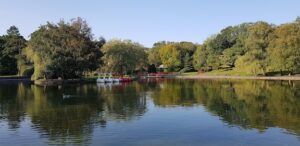
Residents get angry at the amount of Goose Poop accumulating in Aberdare Park

Dog Fouling Extension approved, any fouling by any animal is a danger to Public Health not only dogs
